
How to Style a Console Table Behind a Sofa
If your sofa floats in the middle of the room, you already know the problem: that bare stretch of space behind it can feel awkward, unfinished, or like an afterthought. A well-styled console table solves that instantly, turning a dead zone into one of the most inviting spots in your living room.
Why a Console Table Behind the Sofa Works
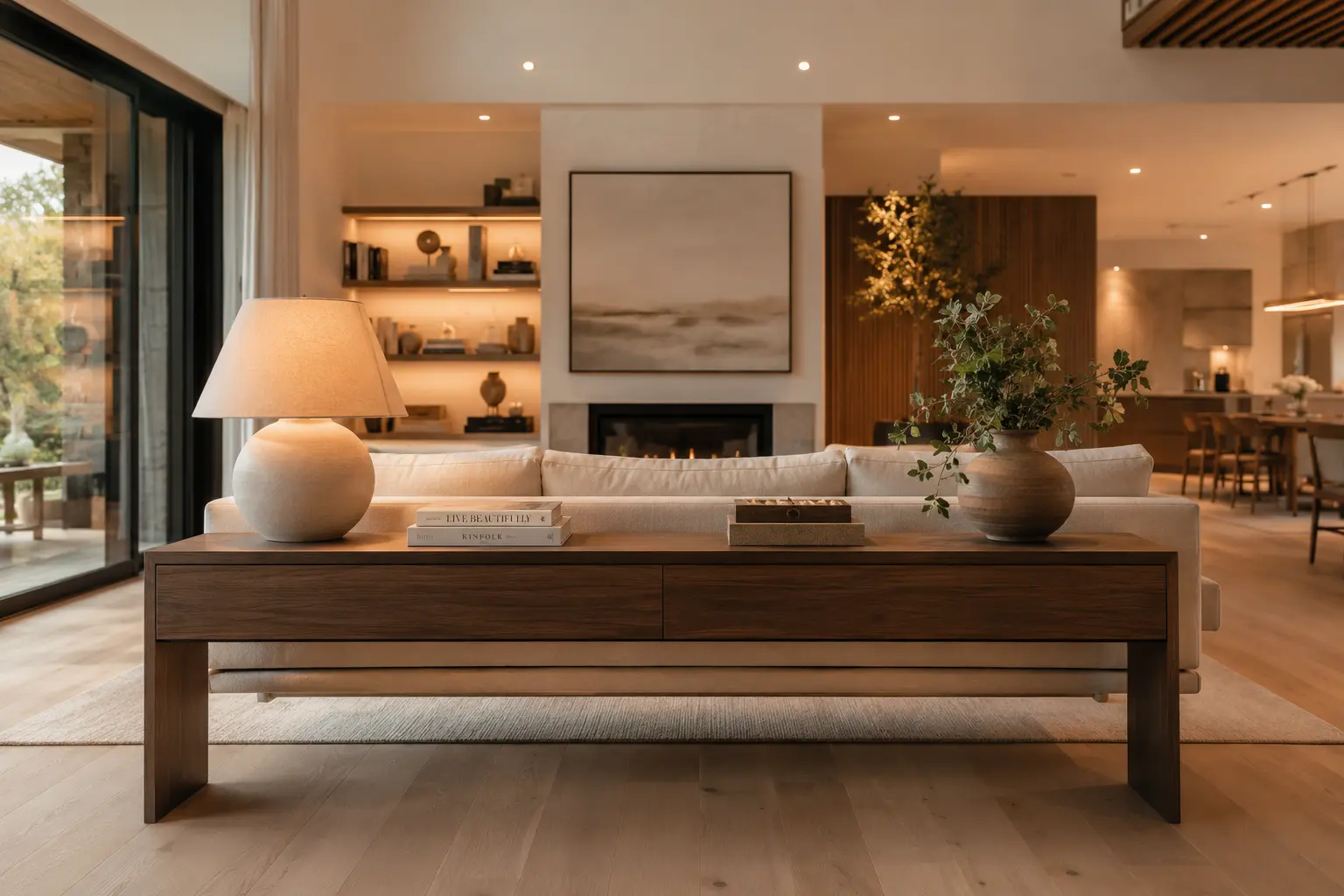
When a sofa doesn't sit against a wall, it can feel like it's floating without purpose, especially in open-concept layouts where the back of the couch faces a kitchen, hallway, or entryway. A console table anchors the sofa and gives the room a sense of intention.
It also solves a practical sightline issue. Instead of looking at cushions and throw pillows from your kitchen or dining area, you get a curated surface of lamps, books, and objects. It's a small addition that changes how the entire room reads.
Getting the Size Right Before You Style
Before you think about decor, the table itself needs to fit the space. Get this part right and styling becomes much easier. We've seen plenty of beautifully decorated tables that still look "off" simply because the proportions were wrong from the start.
Width: Matching Your Sofa
Your console table should be roughly the same width as your sofa, or slightly narrower. If it's too narrow, it will look lost and disconnected. If it extends too far past the sofa's arms, it will look oversized and unbalanced.
Height: Where It Should Sit
As a general guideline, the table sits just below the top of your sofa's backrest, roughly 2–5 cm (1–2 inches) lower. This way it reads as a natural extension of the sofa rather than something towering over it or hiding behind it. The same logic applies to other tables around the sofa; our end table height guide covers it in more detail if you're sizing more than one piece at once.
Depth: Leaving Room to Walk
If the table sits in a walkway, depth and clearance matter as much as width. A narrower profile keeps the space feeling open and easier to move through.
| Element | Recommended Range | Notes |
|---|---|---|
| Table width | Equal to or slightly less than sofa width | Avoid exceeding sofa width by more than a few centimeters/inches |
| Table height | Within 2–5 cm (1–2 in) of sofa back height | Common styling guideline, not a fixed rule |
| Table depth | 25–35 cm (10–14 in) for narrow/walkway spaces | Wider works fine if there's no foot traffic behind it |
| Clearance behind table | At least 60 cm (24 in) | A comfort guideline for easy walking space |
The Styling Method: A Simple Rule of Three
Because a console table behind a sofa usually can't have art or a mirror centered above it, styling it well comes down to a different approach: dividing the surface into three visual sections.
Anchor One End (Height)
Start with a taller item on one side: a lamp, a tall vase, or a stack of oversized books topped with an object. This creates a natural visual anchor without needing anything mounted on the wall.
Anchor the Other End (Height or Function)
Balance the opposite end with another element of height or purpose. This doesn't need to match the first anchor exactly; a second lamp, a sculptural object, or a small plant all work well. The goal is balance, not symmetry.
Fill the Middle (Low Profile)
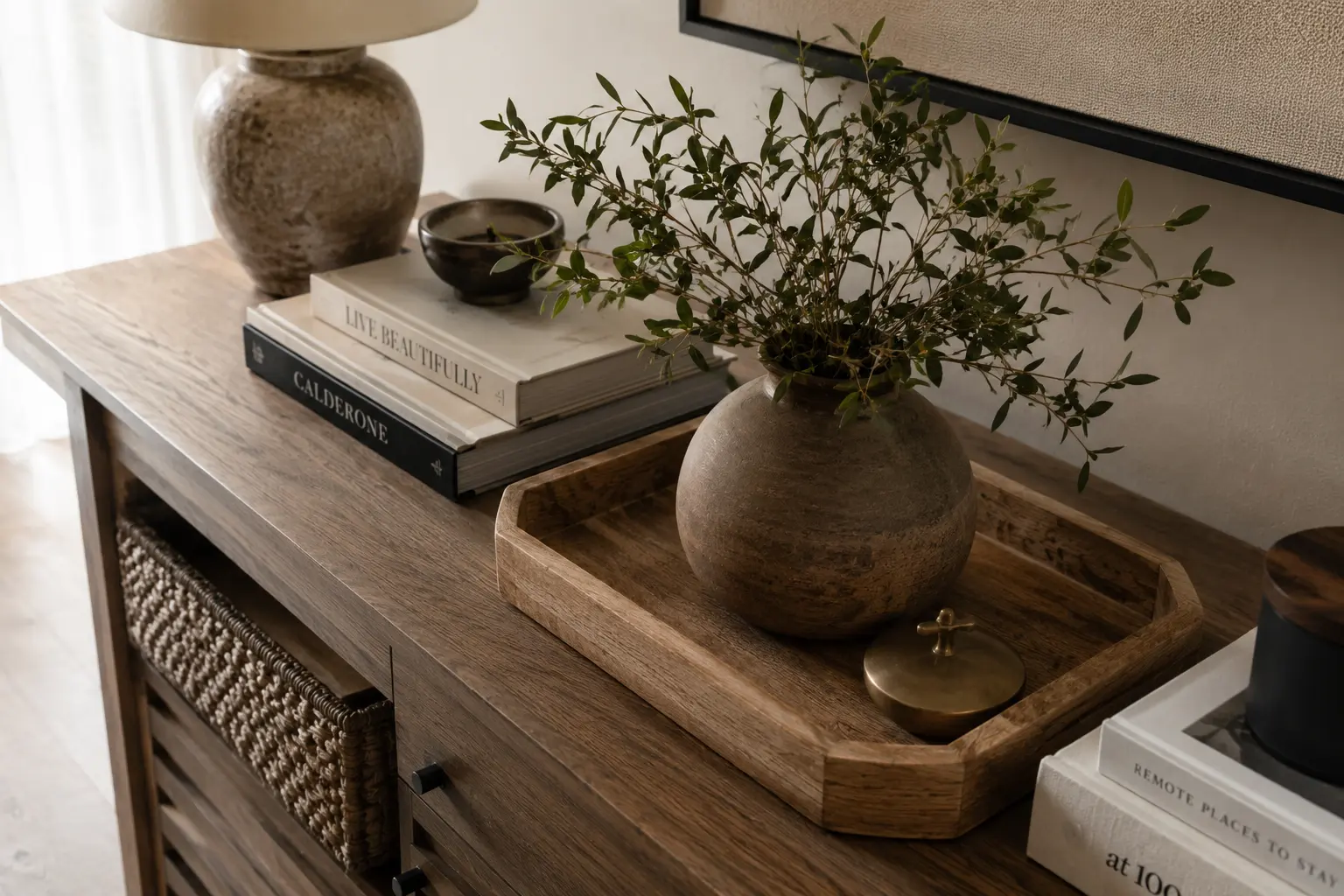
Keep the center low and simple so the table doesn't block sightlines across the room. A shallow tray, a small dish, or a low bowl works nicely here. This is also where a personal touch, like a candle or a small stack of coasters, fits naturally.
Lighting It Right
Lighting does more work on this table than almost any other element, especially in the evening when it becomes a soft secondary light source for the room.
Choosing Lamp Scale and Shade Height
A lamp that's too tall for the table will feel top-heavy, while one that's too small will get visually lost. As a general guide, the lampshade should sit at or just above eye level for someone seated on the sofa.
Cord and Cable Management
Nothing undercuts a styled table faster than a visible tangle of cords. A few simple habits keep things tidy:
- Use cord clips along the back edge of the table or the nearest wall
- Route cords behind a table leg rather than letting them hang loose
- Consider an under-table tray or basket to hide power strips

Layering Texture, Color, and Material
The most visually interesting console tables mix materials rather than sticking to one finish. Try pairing a wood or stone tabletop with ceramic, metal, or woven accents to add depth without clutter.
Keep your palette cohesive. A simple approach is to choose two or three neutral base tones, such as warm wood, cream, and black, then let one plant or a single colorful object provide contrast. This keeps the table feeling calm and considered rather than busy.
Adding Function: Storage and Everyday Use
A styled table doesn't have to be purely decorative. If your console has drawers or shelves, use them for practical items you'd otherwise leave scattered around the living room:
- Remote controls and coasters
- Extra candles or matches
- Table linens or throw blankets
- Charging cables or small electronics
If your table doesn't have built-in storage, a woven basket underneath or a lidded box on top can serve the same purpose while still looking intentional.
Styling for Different Room Layouts
Not every living room has the same setup, so the styling approach can shift slightly depending on your layout.
Open-Concept or Floating Sofa
This is the classic case, where the console table faces a kitchen, dining area, or entry hall. Keep the styling balanced on both sides since the table will likely be viewed from multiple angles, not just from the front.
Behind a Sectional
A longer sectional may need a wider table or two smaller tables placed together to fill the visual length. This also gives you more surface area to work with for the rule-of-three method.
Narrow Gap Between Sofa and Wall
If your sofa sits close to a wall, a slim console table (or even a shelf-style table) can slide into the gap. This is a good option for smaller living rooms where floor space is limited but you still want a place for a lamp or small styling moment. If a full console still feels like too much for the space, a side table is often the better fit; see our guide to choosing the right side table for sizing options that work in tighter footprints.
Common Styling Mistakes to Avoid
A few small missteps come up again and again, even in otherwise well-designed rooms:
- Overcrowding the surface, which makes the table feel cluttered rather than curated
- Choosing a table that's too wide or too narrow relative to the sofa
- Placing a lamp too close to the sofa's edge, where it's easy to bump while leaning back
- Skipping height variation, which results in a flat, one-note display
- Ignoring cord management, which undoes even the best styling choices
In our experience, overcrowding is the most common mistake. It's tempting to fill every inch of surface once you start decorating, but a little restraint almost always looks better in person.
Frequently Asked Questions
How tall should a console table be behind a sofa?
Aim for a height within about 2–5 cm (1–2 inches) of your sofa's backrest, ideally sitting just below it rather than above.
What is the ideal width for a console table behind a couch?
Match your sofa's width as closely as possible, or choose a table slightly narrower. Avoid tables that extend noticeably past the sofa's arms.
What do you put on a console table behind a sofa?
Common choices include a table lamp, a stack of books, a small plant or vase, and one or two decorative objects arranged using height variation.
How much space should you leave behind a console table for walking?
A minimum of about 60 cm (24 inches) of clearance is a widely used comfort guideline for foot traffic.
Can a console table be the same height as the sofa back?
It can, but sitting slightly lower usually looks more natural and keeps the table from visually competing with the sofa.
What's the difference between a console table and a sofa table?
The terms are largely interchangeable. Both refer to a narrow table used behind or near a sofa, though "sofa table" sometimes implies a table specifically sized to match a sofa's length.
How do you style a console table without a mirror or art above it?
Use the rule-of-three method: anchor both ends with taller items and keep the middle low, so the table creates its own focal interest without needing anything on the wall.
What size console table fits a small living room?
Look for narrow depths of around 25–35 cm (10–14 inches) and prioritize a table with some storage, so it stays functional even in a smaller footprint.
A console table behind the sofa is a small piece of furniture that does a lot of quiet work in a room. Once you get the sizing right and lean on a simple styling method, it stops being an awkward afterthought and starts feeling like one of the more thoughtful corners of your home.
Post a Comment for "How to Style a Console Table Behind a Sofa"