
Standard Sofa Dimensions Explained: A Simple Guide to Finding the Right Fit
Buying a sofa without knowing the numbers is one of the easiest ways to end up with a piece that looks great in a showroom but awkward in your living room. Whether you're squeezing a loveseat into a small apartment or anchoring a large family room with a sectional, understanding standard sofa dimensions takes the guesswork out of the decision. Here's what every measurement actually means — and how to use it.
A quick note before we dive in: the ranges below are general guidelines compiled from common furniture industry references, not fixed specifications. Always check the exact measurements on a manufacturer's product page before buying, since designs vary.
What "Standard Sofa Size" Actually Means
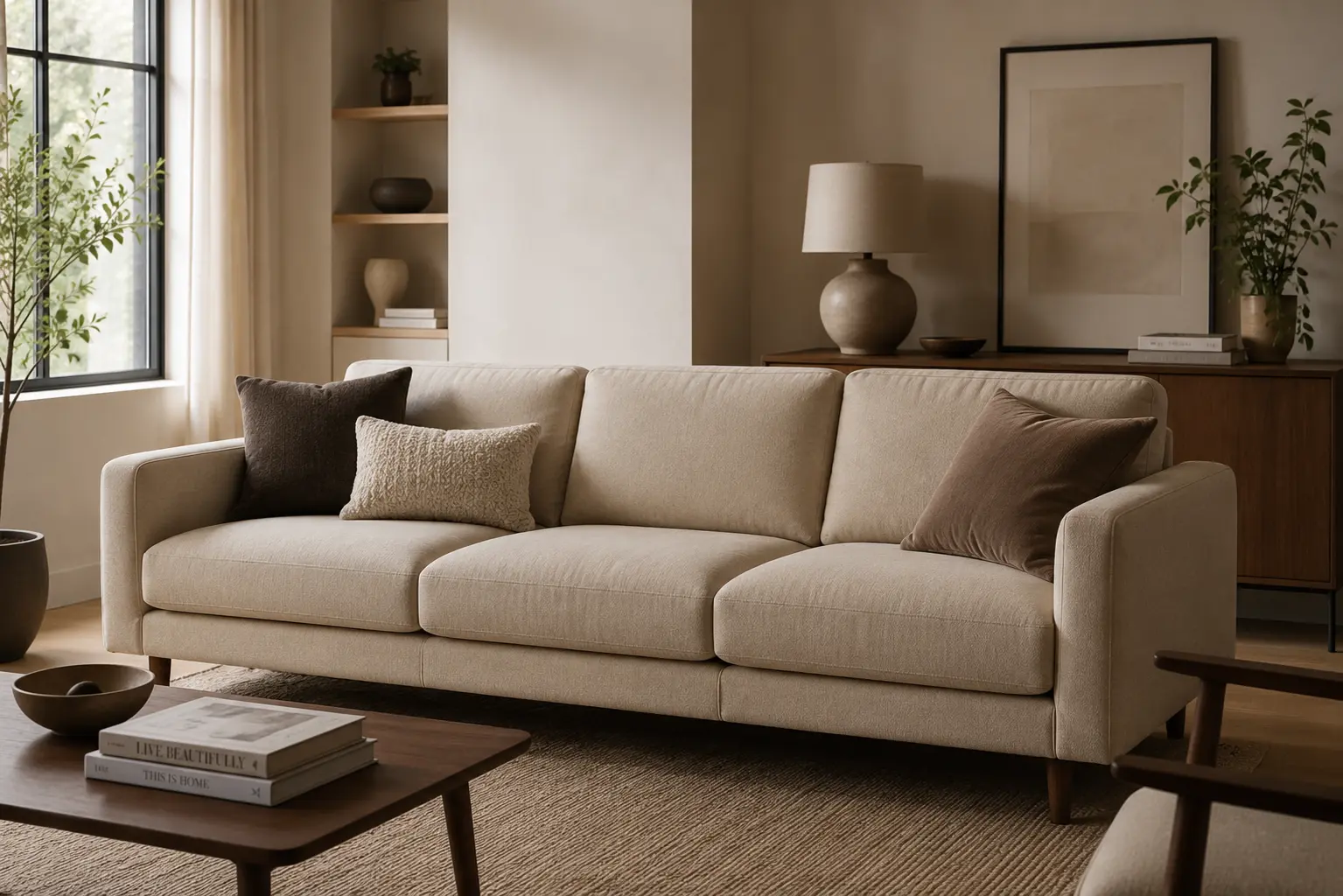
There's no single "correct" sofa size — dimensions shift depending on style, brand, and how a sofa is meant to be used. That said, most three-seat sofas cluster around similar numbers, which is why they're often treated as the industry benchmark.
As a general reference point, a standard sofa typically measures:
- Width: 78–90 in (198–229 cm)
- Depth: 36–40 in (91–102 cm)
- Height: 32–36 in (81–91 cm)
Everything else — loveseats, sectionals, sleepers — is essentially a variation on this baseline, scaled up or down for the number of people it needs to seat. If you're also planning the rug that will sit beneath it, it helps to know your sofa's footprint first.
Sofa Dimensions Glossary
Sofa listings throw around a lot of terms that sound similar but measure different things. Getting these right will save you from ordering something that technically "fits the numbers" but doesn't feel comfortable.
- Width: measured from the outer edge of one arm to the outer edge of the other
- Depth: measured from the front of the seat cushion to the back of the frame
- Height: floor to the highest point of the backrest
- Seat depth: front edge of the cushion to the back edge — this affects how much legroom you have when seated
- Seat height: floor to the top of the seat cushion — affects how easy it is to sit down and stand up
- Back height: top of the seat cushion to the top of the backrest
How to Measure a Sofa Correctly
Always measure at the widest points — armrests, rolled edges, and thick cushions can add several inches beyond what a listing implies. If you're comparing sofas online, check whether the brand includes cushions and pillows in its stated depth, since this can make two "identical" sofas feel quite different in person. When in doubt, a tape measure in your own living room beats trusting a spec sheet alone.
Standard Dimensions by Sofa Type
Sofa dimensions vary considerably by type. The table below gives a quick reference so you can compare at a glance before narrowing your search.
| Sofa Type | Width | Depth | Height |
|---|---|---|---|
| Loveseat (2-seater) | 52–72 in (132–183 cm) | 34–38 in (86–97 cm) | 30–36 in (76–91 cm) |
| 3-seater sofa | 78–90 in (198–229 cm) | 36–40 in (91–102 cm) | 32–36 in (81–91 cm) |
| 4-seater sofa | 110–120 in (279–305 cm) | 36–38 in (91–97 cm) | 32–34 in (81–86 cm) |
| L-shaped sectional | 95–130 in per side (241–330 cm) | 36–40 in (91–102 cm) | 32–36 in (81–91 cm) |
| U-shaped sectional | 120–160 in (305–406 cm) | 36–40 in (91–102 cm) | 32–36 in (81–91 cm) |
| Sleeper sofa (closed) | 78–90 in (198–229 cm) | 36–40 in (91–102 cm) | 32–36 in (81–91 cm) |
Table figures are general market ranges intended for early-stage planning. Confirm exact dimensions against the specific model you're considering.
Loveseat / 2-Seater
Loveseats are the go-to for smaller living rooms, home offices, or as a companion piece to a larger sofa. They keep the same general depth and height as a full sofa — it's really only the width that shrinks.
3-Seater Sofa
This is the size most people picture when they hear "standard sofa." It comfortably fits three adults, though seat width (not just overall width) determines how spacious it actually feels — slim arms and a straight back tend to leave more usable seating room than chunky rolled arms.
4-Seater Sofa
A good option for larger families or open-concept spaces, but it needs a genuinely large wall to avoid overwhelming the room. Measure your wall length before committing to one.
Sectional (L-Shape & U-Shape)
Sectionals vary the most of any sofa style, since each section can be configured differently. As a rough planning guide, a compact L-shaped sectional tends to suit a room around 12 x 12 ft (3.7 x 3.7 m), while a U-shaped version generally needs closer to 16 x 16 ft (4.9 x 4.9 m) to feel balanced rather than cramped. These are starting points, not fixed rules — always map out the footprint in your actual space first.
Sleeper Sofa
A sleeper sofa is close to a standard sofa in its closed dimensions, but the pull-out bed can extend the footprint by another 75–90 in (190–229 cm). Always picture — and ideally measure — how the room will function with the bed fully open, not just closed.
How to Choose the Right Sofa Size for Your Room
The 2/3 Rule
Designers often use this simple proportion check: a sofa should occupy roughly two-thirds of the wall it sits against. A 12 ft (366 cm) wall, for example, suits a sofa around 8 ft (244 cm) long — anything much larger or smaller can throw off the visual balance of the room.
Walkway & Coffee Table Clearance
Leaving enough breathing room around your sofa matters just as much as the sofa's own dimensions:
- Main walkways: 30–36 in (76–91 cm)
- Side passages: 18–24 in (46–61 cm)
- Sofa to coffee table: 14–18 in (36–46 cm)
Planning your coffee table size alongside your sofa makes it much easier to keep these clearances consistent.
Don't Forget Doorway & Delivery Clearance
It's easy to measure a room and forget the path the sofa needs to travel to get there. Before you order:
- Measure the width and height of every doorway, hallway, and staircase turn along the delivery route
- Check the sofa's diagonal measurement (from the back corner to the front arm), not just its width or depth — this is usually the number that decides whether it makes a tight corner
- Ask whether the legs are removable, which can create a few extra inches of clearance if needed
Comfort Factors: Seat Depth and Seat Height Explained

Beyond fitting the room, a sofa needs to fit you. Seat depth and seat height are the two measurements that most affect day-to-day comfort:
- Seat depth of 20–24 in (51–61 cm) suits most people; shorter individuals may prefer the lower end so their feet rest flat on the floor, while taller people often prefer a deeper seat for stretching out
- Seat height of 17–19 in (43–48 cm) is comfortable for most adults, striking a balance between easy sitting and easy standing
- Deep-seat sofas (26–28 in / 66–71 cm) are ideal for lounging but need more floor space and can feel oversized in smaller rooms
Common Sizing Mistakes to Avoid
A few small oversights account for most sofa-sizing regrets. Keep an eye out for these before you finalize a purchase.
- Assuming "standard" means "right for my room" — a sofa can fit physically and still feel out of proportion
- Skipping the doorway and hallway check until delivery day
- Forgetting the sleeper sofa's open footprint — measure the room with the bed extended, not just closed
- Measuring only the overall width and ignoring seat depth, which has a much bigger impact on comfort
- Placing the sofa too close to the coffee table, making it awkward to walk through the space
For a full walkthrough of arranging furniture around your sofa, see our living room layout guide.
Frequently Asked Questions
What is the standard size of a 3-seater sofa?
Most 3-seater sofas measure 78–90 in (198–229 cm) wide, 36–40 in (91–102 cm) deep, and 32–36 in (81–91 cm) high, though exact figures vary by brand.
Is a 72-inch sofa too small?
Not necessarily — it's on the smaller end for a true 3-seater but works well as a spacious loveseat or a compact sofa for tighter apartments and studios.
How much space should be between a sofa and coffee table?
Around 14–18 in (36–46 cm) is generally recommended — close enough to reach items comfortably, but wide enough to walk through.
What's the difference between sofa depth and seat depth?
Sofa depth is the full measurement from the front of the cushion to the back of the frame. Seat depth is just the usable sitting area — the front edge of the cushion to the backrest.
How do I know if my sofa will fit through the door?
Compare the sofa's diagonal measurement (and its height and depth) against your narrowest doorway, hallway, or staircase turn — not just the overall width.
What's the ideal seat height for tall people?
Taller individuals often find 18.5–19 in (47–48 cm) more comfortable, paired with a deeper seat for extra legroom.
How big should my room be for a sectional sofa?
As a rough guide, a compact L-shaped sectional suits a room around 12 x 12 ft (3.7 x 3.7 m), while larger U-shaped sectionals typically need closer to 16 x 16 ft (4.9 x 4.9 m).
What's the difference between a sofa and a couch?
Nothing in terms of dimensions — the two terms are used interchangeably. What actually changes the measurements is the style and type of seating, not the name.
Sofa shopping gets a lot less stressful once you're working with real numbers instead of guesswork. Take the time to measure your room, your doorways, and — just as importantly — think about how you and your household actually like to sit. The right dimensions aren't just about fitting a piece into a space; they're about making sure it feels good to use every single day.
Post a Comment for "Standard Sofa Dimensions Explained: A Complete Sizing Guide"